
Radio Frequency Identification (RFID) has become a game-changing technology for modern businesses seeking higher accuracy, speed, and efficiency. By enabling wireless identification without the need for line-of-sight scanning, RFID delivers real-time visibility that traditional barcodes cannot match. Today, RFID is widely adopted across logistics, retail, manufacturing, healthcare, and agriculture—helping companies automate workflows, reduce errors, and make smarter decisions.
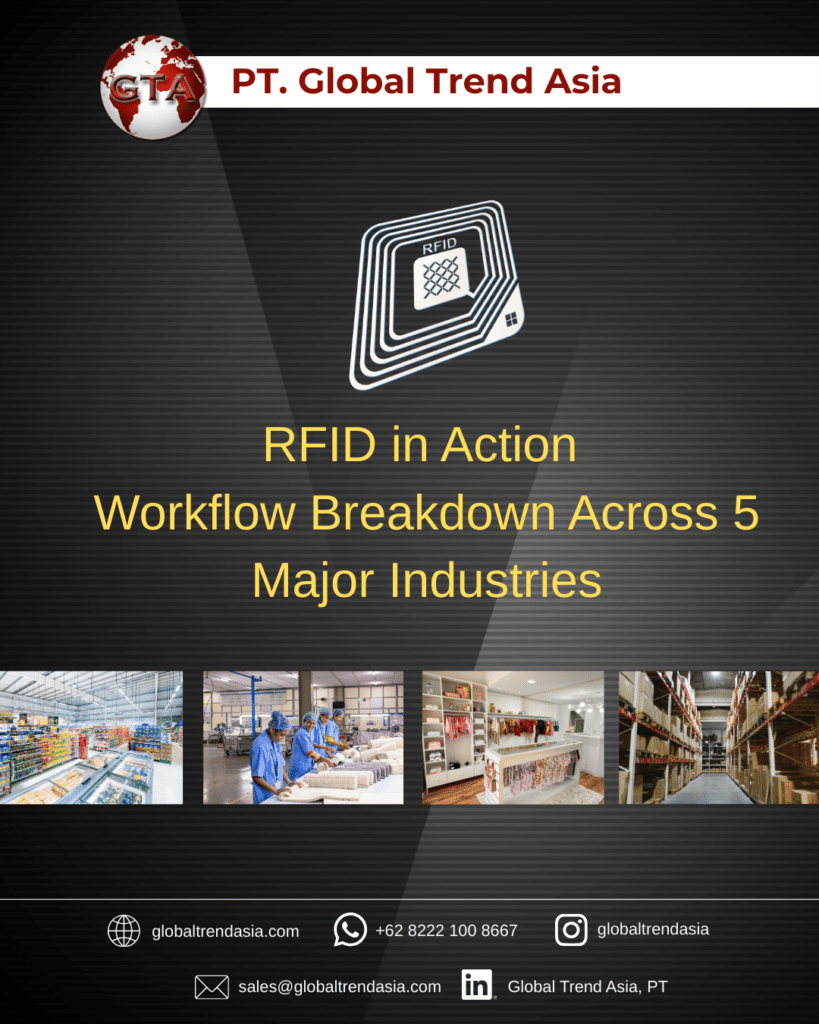
This article breaks down how RFID works in action across five major industries, based on the workflow insights from PT. Global Trend Asia.
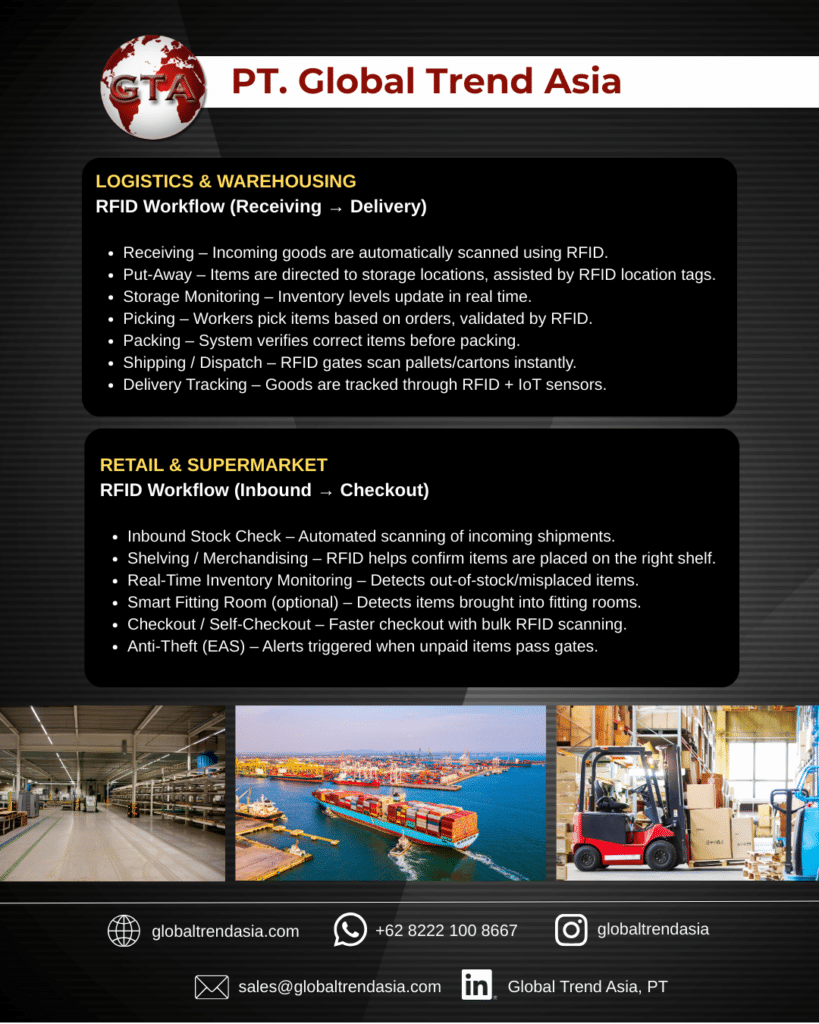
1. Logistics & Warehousing
Workflow: Receiving → Put-Away → Storage → Picking → Packing → Shipping → Delivery
RFID gives logistics operations full visibility from receiving to delivery:
- Receiving: Incoming goods are instantly scanned using RFID, reducing manual errors.
- Put-Away: Tagged items are directed to the correct storage location using RFID-assisted mapping.
- Real-Time Storage Monitoring: Inventory updates automatically as goods move.
- Picking: Workers pick the right items faster, assisted by RFID verification.
- Packing: The system confirms accuracy before items are sealed.
- Shipping: RFID gates scan pallets and cartons in bulk with no delays.
- Delivery Tracking: RFID combined with IoT sensors improves tracking accuracy end-to-end.
This results in faster operations, fewer misplacements, and lower manpower costs.
2. Retail & Supermarket
Workflow: Inbound → Shelving → Inventory Monitoring → Fitting Room → Checkout → Anti-Theft
RFID delivers a seamless, accurate retail experience:
- Automated inbound stock scanning
- Correct and efficient shelf placement
- Real-time inventory visibility
- Smart fitting room capability
- Ultra-fast checkout using bulk RFID scanning
- Enhanced theft prevention using RFID-enabled EAS
Retailers can reduce stockouts, improve product availability, and enhance customer satisfaction.
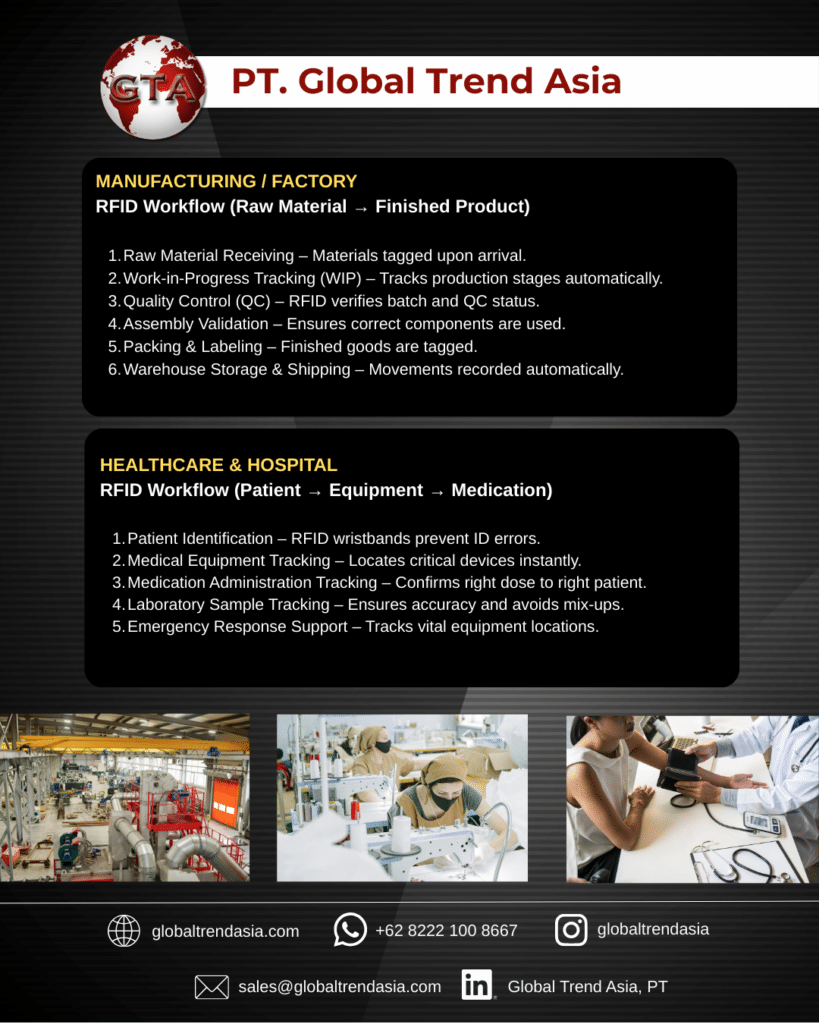
3. Manufacturing / Factory
Workflow: Raw Material → WIP Tracking → QC → Assembly → Packing → Shipping
RFID-enabled factories benefit from:
- Accurate material receiving
- Automatic work-in-progress (WIP) tracking
- Batch verification during quality control
- Component validation to avoid assembly mistakes
- RFID tagging of finished goods
- Effortless warehouse management and shipping accuracy
This makes production lines more traceable, efficient, and error-free.
4. Healthcare & Hospital
Workflow: Patient → Equipment → Medication → Laboratory → Emergency Support
RFID supports safer medical operations by enabling:
- Secure patient identification via RFID wristbands
- Real-time equipment location tracking
- Correct medication administration
- Accurate laboratory sample traceability
- Faster emergency response due to asset visibility
Hospitals experience fewer errors, faster workflows, and improved patient safety.
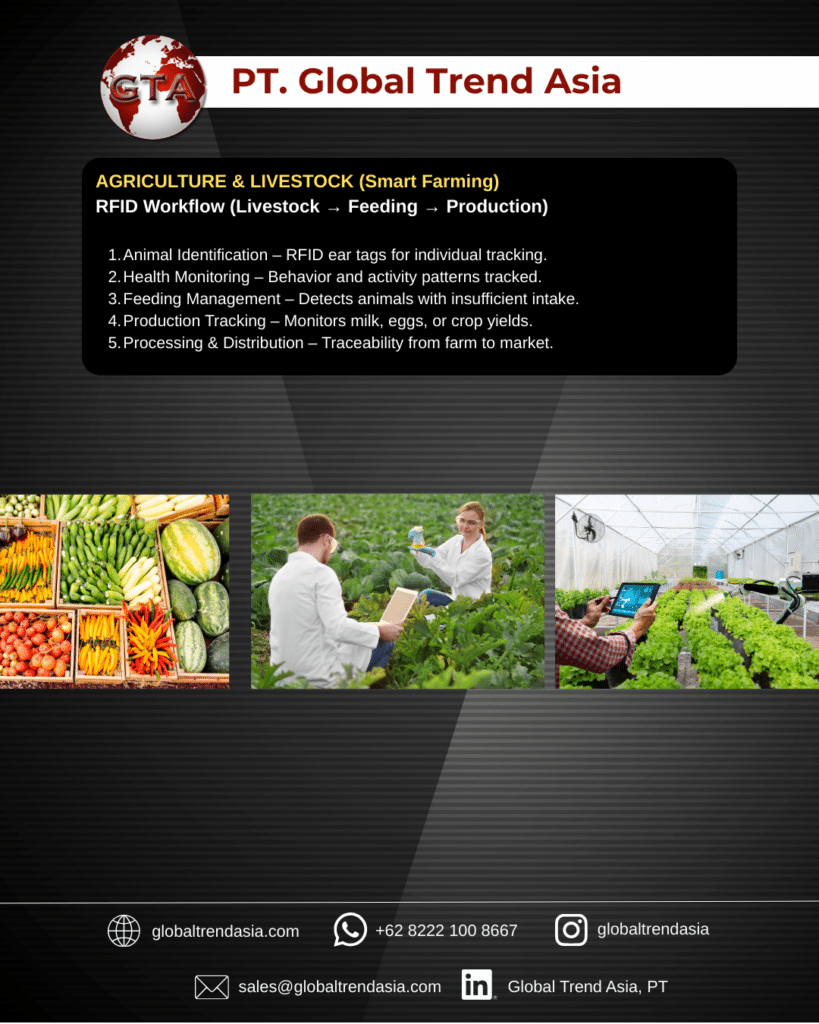
5. Agriculture & Livestock (Smart Farming)
Workflow: Livestock → Feeding → Health → Production → Distribution
RFID supports smart agriculture through:
- Individual animal identification using ear tags
- Animal health and activity tracking
- Feeding pattern monitoring
- Production tracking for milk, eggs, and crops
- Farm-to-market traceability
Farmers benefit from better livestock health, reduced losses, and higher productivity.
Conclusion
RFID is no longer just a supporting tool—it is a core technology that transforms how industries operate. As automation and IoT adoption continue to grow, RFID will play an even bigger role in creating smarter, more efficient, and more connected business ecosystems.
For businesses looking to improve accuracy, reduce errors, and optimize operations, RFID is a proven and essential investment.
Sales & Marketing
Phone: +62 8222 100 8667
Email: sales@globaltrendasia.com