
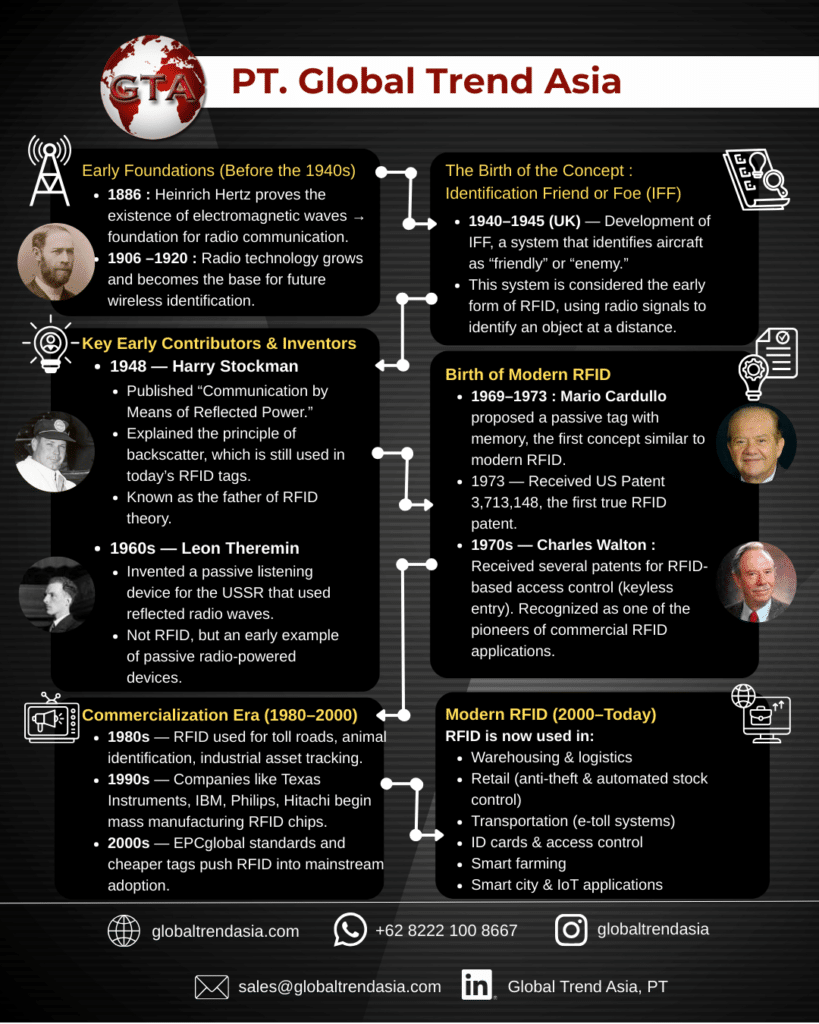
Radio Frequency Identification (RFID) has become one of the most important technologies powering modern logistics, security, retail, and IoT systems. Its evolution spans more than a century, beginning with the discovery of electromagnetic waves and growing into a powerful tool for identifying and tracking objects without direct contact.
Early Scientific Foundations (Before the 1940s)
The roots of RFID can be traced back to 1886 when Heinrich Hertz proved the existence of electromagnetic waves. This milestone laid the groundwork for radio communication, which later evolved into various wireless identification technologies. Between 1906 and 1920, rapid advancements in radio engineering set the stage for future innovations in wireless sensing and identification.
The Birth of the Concept: Identification Friend or Foe (1940–1945)
During World War II, the United Kingdom developed the Identification Friend or Foe (IFF) system to distinguish friendly aircraft from enemies. Although not an RFID system in the modern sense, IFF represents the first practical application of radio waves to identify objects at a distance. This concept would eventually inspire the development of RFID technologies.
Theoretical Breakthroughs (1948–1960s)
In 1948, Harry Stockman published the groundbreaking paper “Communication by Means of Reflected Power,” which introduced the principle of backscatter. This principle is still used in today’s passive RFID tags, making Stockman widely regarded as the father of RFID theory.
In the 1960s, Leon Theremin created a passive listening device for the USSR that used reflected radio waves for power. While not designed for identification, it demonstrated how passive devices could operate without an internal power source—another important step toward modern RFID technology.
The Birth of Modern RFID (1969–1973)
Mario Cardullo played a major role in shaping today’s RFID systems. In 1969, he proposed an electronic tag with built-in memory—a concept very similar to modern passive RFID tags. In 1973, he received US Patent 3,713,148, widely considered the first true RFID patent.
Around the same time, Charles Walton developed multiple patents related to RFID-based access control, including early forms of keyless entry. His innovations helped push RFID into practical commercial applications.
Commercialization and Growth (1980–2000)
By the 1980s, RFID was being used for toll road payments, livestock management, industrial tracking, and security.
In the 1990s, major companies such as Texas Instruments, IBM, Philips, and Hitachi began mass-producing RFID chips, making the technology more affordable and scalable.
The early 2000s marked a turning point, with EPCglobal establishing standards that enabled worldwide RFID adoption. This period saw explosive growth in retail, warehousing, and logistics.
Modern RFID: Widely Adopted and IoT-Connected (2000–Today)
Today, RFID is deeply integrated into business operations and smart technology systems. It is widely used for:
- Warehousing and logistics
- Retail inventory automation and anti-theft
- Transportation and e-toll systems
- ID cards and access control
- Smart farming and livestock tracking
- Smart city and IoT applications
RFID continues to evolve alongside IoT, cloud computing, and automation, making it a key enabler of efficiency and real-time visibility in the modern world.
Sales & Marketing
Phone: +62 8222 100 8667
Email: sales@globaltrendasia.com